Living in Cabo San Lucas, and owning a house there
Living in Cabo San Lucas is usually described from the marina. What reaches a house is two facts that are rarely put side by side: the town has grown at a rate that stands out nationally, from 37,984 residents in 2000 to 202,694 in 2020, counting the neighbourhoods joined to it, and it sits at the dry end of a peninsula, where the town's own weather station records 258.6 millimetres of rain in a normal year. A city still catching up with itself, in a place where water is stored rather than expected, is the house's real setting.
This guide answers the question people ask before they buy — what the town is, how it differs from its neighbour, what the year does to a house — only as far as it takes to reach the question they ask afterwards, which is what that house needs while they are somewhere else. How looking after one there is organised is on the page for Los Cabos.
What is Cabo San Lucas like to live in, beyond the marina?
It is the larger of two towns in a young municipality of 351,111 people, and the one that grew fastest: a working city built around the hotels, where most residents came from somewhere else. The marina is one corner of it; what an owner deals with — offices, suppliers, the people who come to the door — belongs to the town that grew up behind it.
The municipality is younger than many of the houses in it. The municipal historical archive records that San José del Cabo depended on other authorities hasta 1980, cuando se decreta la creación del Municipio de Los Cabos, integrado por las Delegaciones Municipales de Santiago, Miraflores, San José del Cabo y Cabo San Lucas, and that San José del Cabo was declared the municipal seat. Cabo San Lucas, the better-known name, is one of the four delegations, not the seat.
The census counts what came next. INEGI's results for the state put Los Cabos as the most populous municipality, with 351,111 residents, and the state tourism ministry's profile of the municipality, built on the same census, gives an average annual growth of 4.0% between 2010 and 2020, against 8.2% in the decade before. A town that grows at that pace builds its roads, water mains and offices after the houses that need them, and a house bought there is bought inside that process rather than after it.
Then there is the question the search box is full of: living in Cabo San Lucas as an American. The census does not count residents by passport, but it does record where they were born, and in Los Cabos 55.8% of the population was born in another state or another country, the highest share in Baja California Sur. A town where one resident in two arrived from elsewhere is used to newcomers; what it does not supply on its own is somebody at the house when the owner is away. For an American owner the legal fact that comes first is that the whole coast lies inside the faja del territorio nacional de cien kilómetros a lo largo de las fronteras y de cincuenta a lo largo de las playas, so the house is held through a bank trust; what that changes is set out in the guide to buying a house in Mexico as an American.
How do Cabo San Lucas, San José del Cabo and the corridor between them differ for a house?
San José del Cabo is the older town and the municipal seat, built where an oasis gave it water; Cabo San Lucas is the port at the tip that grew fastest; the corridor between them is a line of private communities along one road. For a house, the difference decides which town its offices, trades and supplies come from, and how far they travel to reach the gate.
San José was not placed by chance. The state's profile of the municipality names Santiago and San José del Cabo as the oases of the area, historic settlements en los cuales la existencia de recursos acuíferos permitió su supervivencia, and beside the town lies the Zona Sujeta a Conservación Ecológica Estero de San José del Cabo (473 has), the only reserve in the state administered by a municipality. Cabo San Lucas grew from the other end, around the bay and the port: in 2010 San José was still the slightly larger town, and by 2020 Cabo San Lucas was far larger.
| Place | 2000 | 2010 | 2020 | What it means for a house |
|---|---|---|---|---|
| Cabo San Lucas | 37,984 | 68,463 | 202,694, with Colonia del Sol and Las Palmas | The larger town, around the bay and the port, and the end of the municipality where most residents now live |
| San José del Cabo | 31,102 | 69,788 | 136,285, with the localities joined to it | The municipal seat, beside the oasis and the estuary that first gave the area its water |
| Municipality of Los Cabos | — | — | 351,111 | One municipal government for both towns and the corridor between them |
The 2020 figures for both towns include neighbourhoods that the earlier censuses counted as separate localities, which is why the jump looks steeper than the growth rate. The road between the towns, and the three stretches into which the published figures for it are divided, are written out on the page for property management in Los Cabos, and this guide does not repeat them.
What do the desert and the sea ask of a house there?
They ask for two kinds of care at once: protection from the salt the sea carries in, and management of water in a place where it barely rains. The station at Cabo San Lucas records 258.6 mm a year over 13.3 rainy days, so nothing rinses the salt off between storms and the house keeps its own water.
The national weather service's normal for the station named Cabo San Lucas, fifteen metres above sea level, issued on 16 October 2026, gives a mean annual temperature of 24.3 °C and 258.6 mm of rain over 13.3 rainy days, with April at zero. How salt settles on a house that faces the water, and why the desert never washes it off, is the subject of the guide to the Sea of Cortez; the year month by month is in the guide to Cabo weather.
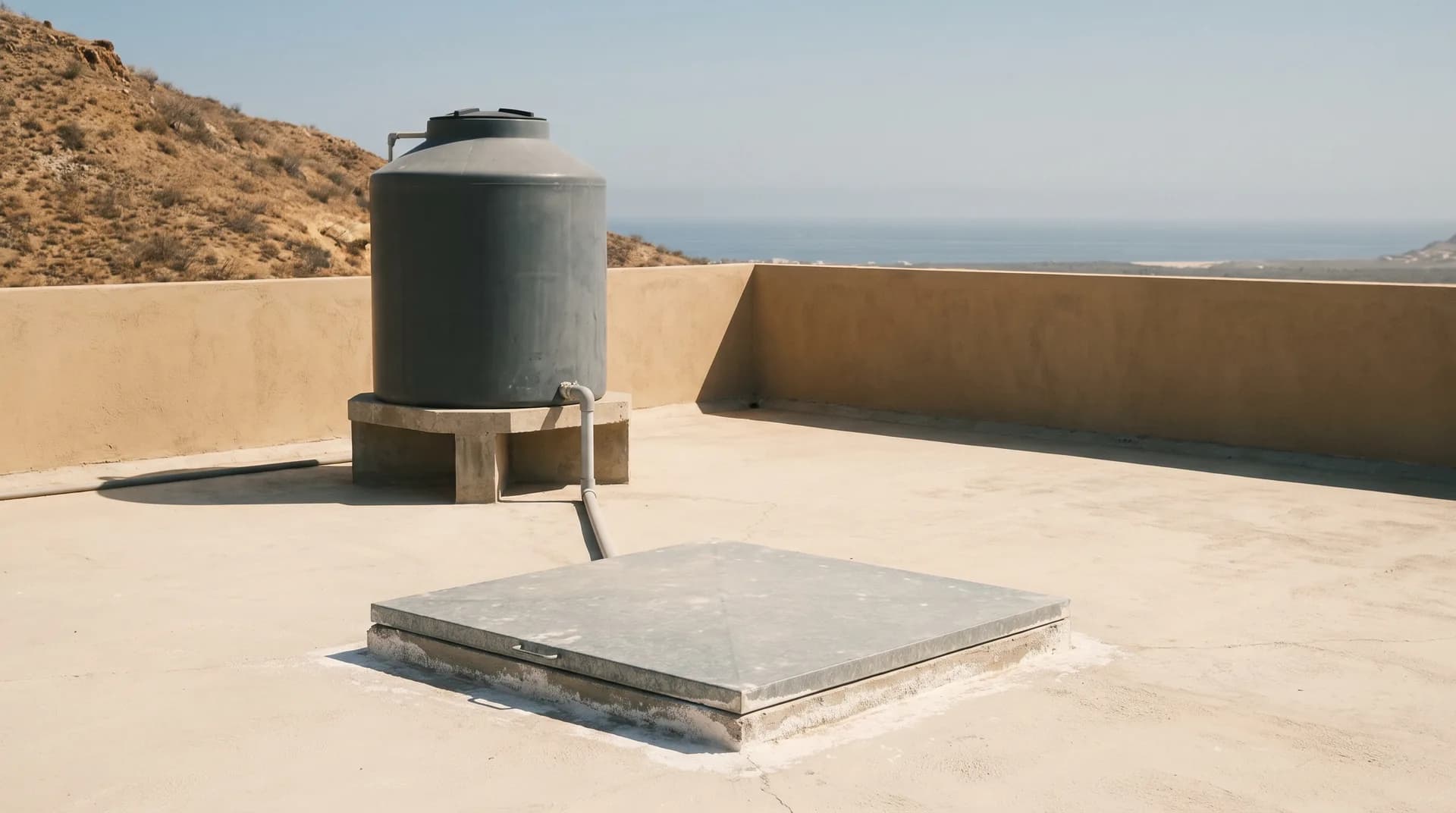
What the census adds is how the town's houses live with that dryness. In the municipality, 90.6% of homes had piped water in 2020, 77.7% had a tinaco and 31.1% a cisterna o aljibe. A roof tank and an underground cistern are not extras here; they are how a house keeps water between deliveries, and both are equipment that works, fails or goes stale whether or not anyone is in the house.
The pros and cons of living in Cabo San Lucas, read from the house rather than from the street, sit in those figures. On one side, a dry winter with normal highs of 26.6 °C in January and 27 °C in February, in which outside work is easy to schedule. On the other, an August with normal highs of 34.7 °C, salt on every exposed surface, and water that has to be stored, checked and kept clean on site.
What does the hurricane season change for an owner?
It sets a deadline: the eastern Pacific season runs from 15 May to 30 November, and the rain of the year arrives inside it, with August and September bringing 190.4 of the station's 258.6 mm. Whatever needs checking on the roof, the drains and the openings is done before the season, and checked again after any storm.
The National Hurricane Center states that the eastern Pacific hurricane season runs from May 15 to November 30, two weeks earlier than the Atlantic season that governs the Caribbean coast. The station normal shows the same months from the other side: 76.4 mm in August and 114 mm in September, most of the year's water in sixty days. Which storms have reached this coast, and where the official warnings come from, is set out in the guide to hurricane season in Cabo San Lucas; what Hurricane Odile in 2014 changed about how houses are built and checked is in the guide to the Sea of Cortez.
For an owner who is away, the season changes the calendar more than the house. Work that can wait in March cannot wait in August, and a storm that passes in September is followed by a check that somebody has to make within days, not on the next visit.
What does a house need when its owner is there only part of the year?
It needs a record of its water and its salt — what is stored, what is consumed, what is corroding — and someone present on the days when a delivery, a supplier or a storm decides. In a dry town a stale tank or a failing pump does not announce itself; it is found on arrival.
Part-year houses are a recognised share of this state's housing. INEGI's results for Baja California Sur count 299,681 private dwellings, of which 80.2% are inhabited, 11.9% uninhabited and 7.8% used temporarily, and in Los Cabos itself only 59.3% of inhabited homes are occupied by their owners, the lowest share in the state, with 30.8% rented. A house whose owner lives elsewhere is ordinary here, which is why the arrangements around it are worth writing down rather than improvising.
So the brief for an absent owner here has a particular shape. Four items carry most of it, and none of them is urgent on the day it is agreed, which is why it is worth agreeing.
Most of that is maintenance with a date on it, which is what preventive maintenance means in practice, set out over twelve months in an annual plan. All of it produces paper that is wanted months later, and it belongs with the amounts in the monthly owner statement, so that a question asked in January about a September storm has somewhere to land.
Who looks after it the rest of the time?
Someone who works for the owner and answers for the whole house: keys, suppliers, the maintenance calendar and the accounts, in one place and in writing. In a town that has grown this fast the tasks are not unusual; what matters is that one person is accountable for all of them.
That is the job described in the guide to what a property manager does, and in its full form as luxury property management. What changes in Cabo San Lucas is the list of things to watch rather than the role: stored water, salt on metal, a short wet season inside a long storm season, and a town whose services are still being built around the houses. How that is organised along the road between the two towns is on the page for Los Cabos.
What is it like living in Cabo San Lucas?
Cabo San Lucas is the larger of the two towns of the municipality of Los Cabos, at the southern tip of Baja California Sur. The census counted 37,984 residents in 2000 and 202,694 in 2020, including the neighbourhoods joined to it, in a municipality of 351,111 people where 55.8% of residents were born in another state or another country. It is a dry place: the town's weather station records 258.6 mm of rain in a normal year, most of it in August and September, and a mean annual temperature of 24.3 °C.
Is Cabo San Lucas the same as Los Cabos?
No. Los Cabos is the municipality, created by a decree of 1980 that separated it from La Paz, made up of the delegations of Santiago, Miraflores, San José del Cabo and Cabo San Lucas. Its seat is San José del Cabo, not Cabo San Lucas. The two towns are joined by a road along which many private communities stand, and the municipality had 351,111 residents at the 2020 census.
How much does it rain in Cabo San Lucas?
Very little. The national weather service's 1991 to 2020 normal for the Cabo San Lucas station, issued on 16 October 2026, records 258.6 mm of rain a year over 13.3 rainy days. August brings 76.4 mm and September 114 mm, and April averages zero. Because the rain is so scarce, most homes in the municipality store water on site: in 2020, 77.7% had a roof tank and 31.1% a cistern.
When is hurricane season in Cabo San Lucas?
Cabo San Lucas follows the eastern Pacific hurricane season, which according to the National Hurricane Center runs from 15 May to 30 November, two weeks earlier than the Atlantic season that governs the Caribbean coast of Mexico. Most of the year's rain falls inside that season, in August and September. Checks on roofs, drains and openings are best done before mid-May and again after any storm that passes close to the coast.
Can an American own a house in Cabo San Lucas?
Yes, through a bank trust. The Mexican foreign investment law defines the restricted zone as the strip of national territory one hundred kilometres wide along the borders and fifty kilometres wide along the coasts, and Cabo San Lucas lies inside it. Within that zone a foreign individual holds residential property through a trust held by a Mexican bank rather than in direct ownership. The terms of the trust, its duration and its renewal are matters for the notary and the bank handling the purchase.