Cabo weather, month by month, for an owner
Cabo weather is usually summed up as sunshine all year, and the official record mostly agrees: across the 1991-2020 normal the station at Cabo San Lucas logs 265 mm of rain on 13.9 days a year, and close to three quarters of it falls in August and September. For a house, that is the whole story in one line. The calendar on this coast is set less by the rain than by its absence.
Most of what is written about the weather in Los Cabos, Mexico, is written for somebody choosing the week of a trip. This guide reads the same numbers from the other side of the window: not what a month will feel like on the terrace, but what it does to a house between the desert and the sea while its owner is somewhere else. What the house itself asks for on each stretch of this coast is set out on the page for Los Cabos.
What is the weather in Cabo like through the year?
It is warm and dry in almost every month: monthly mean temperatures run from 19.7 °C in January to 29.3 °C in August, and the whole year brings 265.0 mm of rain across 13.9 days. Almost all of it arrives between July and October, and from March to June the station records 1.9 mm in four months, with April at zero.
For anyone asking what Cabo San Lucas weather means for a building, the useful comparison is with the other two coasts. Acapulco gets about 1,240 mm in one long wet season; Cancún gets about 1,370 mm spread over most of the year. Cabo San Lucas gets a fifth of either, and it gets it on fewer days than Cancún has rain in October alone. A house here is not tested by water that keeps coming back. It is tested by the months in which nothing comes at all.
The figures below come from station 3005, Cabo San Lucas, of the National Meteorological Service, fifteen meters above sea level, on the 1991-2020 normal, with between 26 and 30 years of data in each column. The normal does not publish humidity or evaporation for this station, so the table carries only what the station measured: temperature, rainfall and the number of days on which it fell.
| Month | Normal high / low (°C) | Rainfall (mm) | Days with rain |
|---|---|---|---|
| January | 26.6 / 12.8 | 6.0 | 0.9 |
| February | 27.1 / 12.9 | 4.7 | 0.6 |
| March | 28.5 / 13.9 | 1.4 | 0.3 |
| April | 30.1 / 15.4 | 0.0 | 0.0 |
| May | 32.1 / 16.5 | 0.1 | 0.1 |
| June | 32.6 / 18.5 | 0.4 | 0.1 |
| July | 34.4 / 22.4 | 7.8 | 1.0 |
| August | 34.7 / 23.8 | 85.1 | 3.6 |
| September | 33.7 / 23.3 | 110.0 | 4.0 |
| October | 33.4 / 21.2 | 25.3 | 1.4 |
| November | 30.4 / 17.5 | 16.9 | 1.1 |
| December | 27.4 / 14.0 | 7.3 | 0.8 |
| Year | 30.9 / 17.7 | 265.0 | 13.9 |
Read the two rain columns together and the year divides in a way no travel calendar shows. Ten months share 69.9 mm between them, less than September delivers on its own. The other two carry 195.1 mm on 7.6 days, which means that on this coast a rainy day is an event, and that most of a year's water reaches a roof in a handful of afternoons.
Which are the hottest months in Cabo, and which are the mildest?
The hottest stretch is July to September, with August at a normal high of 34.7 °C and a normal low of 23.8 °C, and the station's highest reading across the normal was 44 °C, on 16 September 2005. The mildest months are January and February, with normal highs of 26.6 °C and 27.1 °C and lows below 13 °C.
What the averages hide is the spread inside a single day. In January the normal high and low are 13.8 degrees apart; in August, 10.9. A desert coast warms fast under a cloudless sky and gives the heat back to the same clear sky at night, so every exposed surface on the house — render, sealant, metal, glass, timber — moves through that range every twenty-four hours, all year, whether anybody is there or not.
Winter nights can be cooler than the averages suggest. The lowest reading in the record was 1.5 °C, on 1 February 1991, and December's lowest was 2 °C, in 2017. Those are single nights in thirty years, and no house here is built to be heated; they are worth knowing only because they are the nights on which an outdoor pipe, a pool heater or a plant somebody cares about is closest to its limit.
When does the little rain that falls on Los Cabos arrive?
Almost all of it arrives in August and September, which together carry 195.1 of the year's 265.0 mm, and with October they carry 220.4 mm, about five sixths. Those are the same weeks in which the eastern Pacific hurricane season, which officially runs from 15 May to 30 November, has most of its activity: the National Hurricane Center places most tropical cyclones in that basin between late June and early October.
That coincidence is the important fact about rain on this coast. Over the normal, the wettest month at Cabo San Lucas averages 110 mm. The record is something else entirely, and the record is what a roof, a terrace outlet or a hillside drainage channel actually has to survive.
The station's wettest month was August 2017, at 452 mm, and its wettest single day was 400 mm, on 31 August 2017 — the day Tropical Storm Lidia passed very close to Cabo San Lucas, before moving along the west coast of the peninsula. One day of one storm brought the station half again as much rain as its whole normal year. Three years earlier Hurricane Odile made landfall just to the east of Cabo San Lucas as a category 3 hurricane, on 15 September 2014. What that storm measured, and what it changed about how houses here are built and checked, is set out in the guide to the Sea of Cortez.
So the practical calendar has two halves of very different length. From November to June rain is close enough to absent that nothing on the house is planned around it. From July to October it is unlikely on any given day and decisive when it comes, and the preparation for it has to be finished before the season opens rather than when a storm is named.
What does a dry, salty climate do to a closed house?
It deposits salt and dust on every exposed surface for months and never washes either off, while sun and the daily temperature swing work on sealants, paint and finishes. Nothing in a closed house here rots quickly; nothing gets cleaned by the weather either, so the condition of each surface is close to the sum of the days since somebody last touched it.
The mechanism — the sea air that carries the salt, the desert air that evaporates far more water than ever falls, and the hardware on which the two meet — is set out in full, with its measurements, in the guide to the Sea of Cortez. For the calendar, the consequence is simpler. On a wet coast the risk in a closed house is damp that settles; on this one it is a crust that builds.
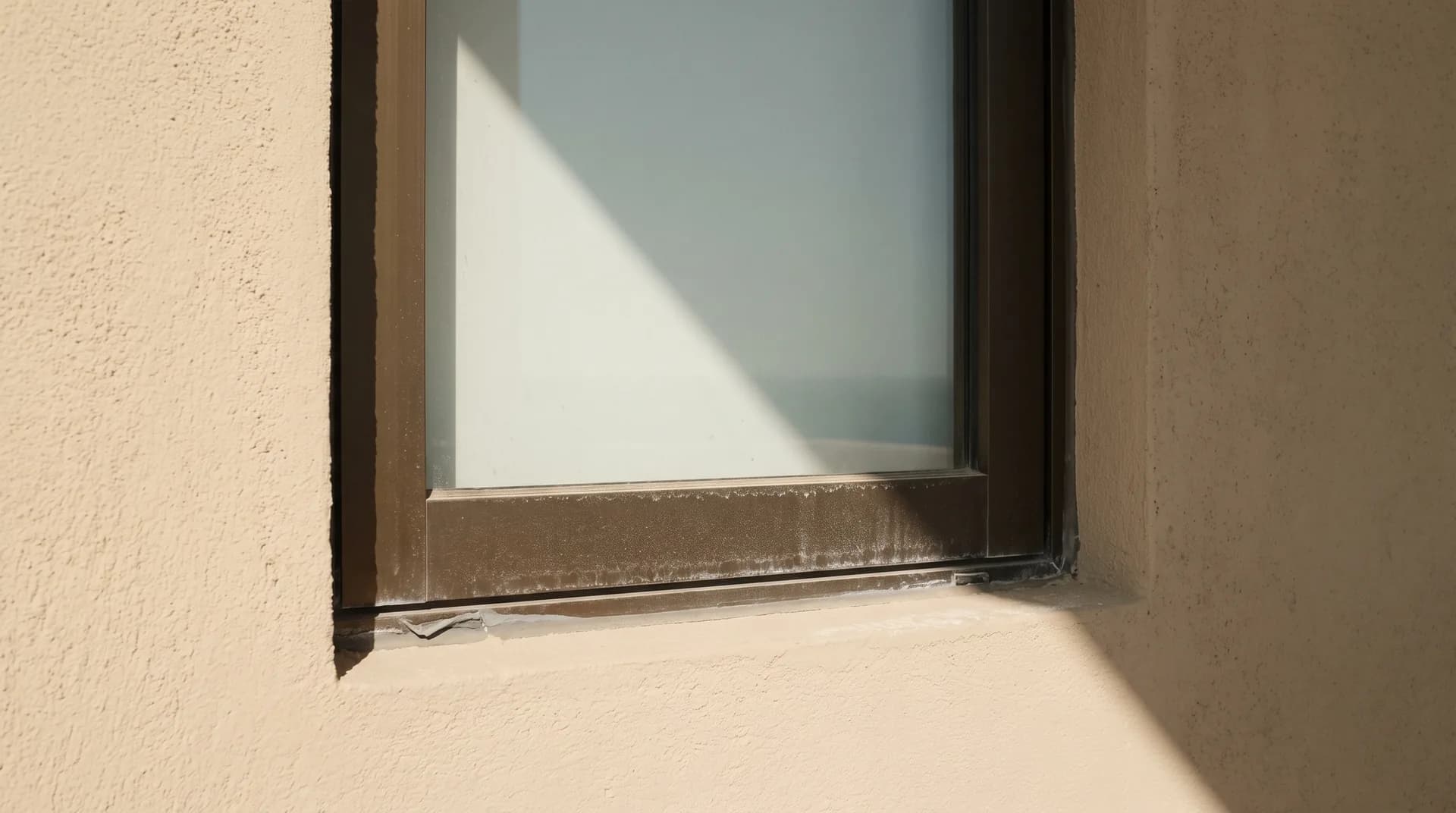
In practice the metal goes first: hinges and bolts, sliding-door tracks, balcony rails, gate motors, air-conditioning condensers and pool equipment, anything outdoors and facing the water. Then the joints: silicone and sealant around windows and doors that harden and pull away after a summer of sun, and render that crazes along the same lines year after year. Inside, the closed house collects fine dust behind every door that does not seal, and glass and stone on the sea side carry a film that does not leave on its own.
The rain, when it comes, does not reset any of that. A storm that drops a season's water in an afternoon tests drainage that has been dry and full of windblown sand for ten months, and it finds every outlet, channel and downpipe that nobody cleared. That is why the work on this coast is set by an interval and a deadline, not by the weather of the week.
What is Cabo San Lucas weather in December and January?
Cabo San Lucas weather in December is warm by day and cool at night, with a normal high of 27.4 °C and a low of 14.0 °C, and almost dry: 7.3 mm across 0.8 days of rain. Cabo weather in January is the mildest of the year, at 26.6 °C and 12.8 °C, with 6.0 mm across 0.9 days.
These are the months in which the outside of the house can be worked on in the most comfortable conditions of the year, and the ones in which its occupants are most likely to notice the evening chill. A terrace that is pleasant at noon in January is cool by nine at night, which is when the heaters, the fireplaces and the outdoor showers that nobody used in August are suddenly asked for.
They are also the months in which the summer's damage is easiest to read. After the last storm of the season, three months of dry air have usually left every stain, every lifted joint and every blooming hinge plainly visible, and nothing new is about to hide it.
Which months is the house most likely to be in use?
That is set by the owner's own year rather than by the climate, and for an owner who lives farther north it tends to mean a house opened between December and April and shut through the hot months and the storm season. On this coast the two calendars fit together better than on most: the months an owner from the north is most likely to be there are the coolest of the year, and among the driest.
The difficulty is the other side of it. The months the house is most likely to stand empty, July to October, are the hottest, the ones with nearly all the rain, and the ones inside the most active part of the cyclone season. Whatever condition the house is in when its owner next opens the door is decided, almost entirely, in those four months.
There is one useful overlap. The long dry stretch from November to June includes the weeks an owner is most likely to be present, which makes it the natural time to see exterior work being done — painting, sealing, metalwork, roofs and drainage — rather than to hear about it afterwards.
What should an owner abroad have checked each season?
Three moments fixed by the calendar rather than by anybody's flight: one in early May to close out the house before the cyclone season opens on 15 May, one in November after it, and a fixed interval in between for what the salt does without any season at all. The storm visit has a deadline; the salt visit has a frequency.
The May visit is drainage and storm readiness: roofs and terrace outlets cleared of sand and run with water, hillside channels above the house opened, downpipes proved to discharge away from the walls, sealant runs and window seals checked along their length, shutters and fixings tested, anything loose on a terrace secured or brought in, pumps and gate motors serviced. It is the plain content of preventive maintenance, and it is finished by a date, not started when a forecast arrives.
The November visit is the same list read backwards, and it is the one that produces information: where water ran that it should not have, which joint opened, which outlet silted up, what the summer's sun did to the sealant on the west face, which hinge, lock or condenser has started to bloom. What it finds goes into the long dry window that follows.
That window, November to June, is the stretch in which paint, render and sealant can be applied and left to cure without rain, and the one in which an owner is most likely to see the work. What to do in it — which elevation this year, which metalwork, which roof — is a decision taken before it opens, as part of an annual plan, not a quotation sought after the first storm.
None of this helps an owner two thousand miles away unless it arrives in a form they can check without asking — dated, itemized, with photographs and the spending against them. That is what the monthly owner statement is for, and for a house on this coast the months that weigh most in it are July to November. How the rest of the work looks here, stretch of coast by stretch of coast, is on the page for Los Cabos.
What is the weather in Cabo like month by month?
Warm and dry in almost every month. On the National Meteorological Service normal for 1991-2020, the Cabo San Lucas station records monthly mean temperatures from 19.7 °C in January to 29.3 °C in August and 265.0 mm of rain across 13.9 days a year. August and September together bring 195.1 mm, and from March to June the station records 1.9 mm in four months.
When does it rain in Cabo San Lucas?
Mostly in August and September, with a little in July, October and November. Those months fall inside the eastern Pacific hurricane season, which runs from 15 May to 30 November and has most of its activity between late June and early October, so much of the year's rain arrives with tropical storms. The station's wettest day on record was 400 mm on 31 August 2017, when Tropical Storm Lidia passed very close to Cabo San Lucas.
What is Cabo San Lucas weather like in December?
Warm by day, cool at night and almost dry. The normal December high is 27.4 °C and the low 14.0 °C, with 7.3 mm of rain across 0.8 days. January is the mildest month of the year, with a normal high of 26.6 °C and a low of 12.8 °C.
What does a closed house in Los Cabos need before the storm season?
Drainage that has been cleared and tested with water, and it needs it by mid-May, when the eastern Pacific hurricane season opens, because the rain on this coast arrives late in the summer and mostly with tropical storms. That means roofs, terrace outlets and hillside channels cleared of sand, downpipes proved to discharge away from the walls, window seals and sealant checked, shutters and fixings tested, pumps and gate motors serviced, and anything loose on a terrace secured or brought in.