Living in Tulum, and owning a house there
Living in Tulum is usually described as a beach and a jungle. What reaches a house is two facts that are rarely put side by side: the municipality is younger than most of the houses people buy in it, created by a decree of the state congress published in the Periódico Oficial del estado de Quintana Roo on 19 May 2008, and the ground under it is, in the words of a federal decree, a limestone platform whose relieve kárstico de la región, mismo que favorece la filtración de agua hacia el subsuelo. A young town on porous rock, with water underneath and protected land at its edges, is the house's real setting.
This guide answers the question people ask before they buy — what the town is, where the houses are, what the year does to them — only as far as it takes to reach the question they ask afterwards, which is what that house needs while they are somewhere else. How looking after one there is organised is on the page for Tulum.
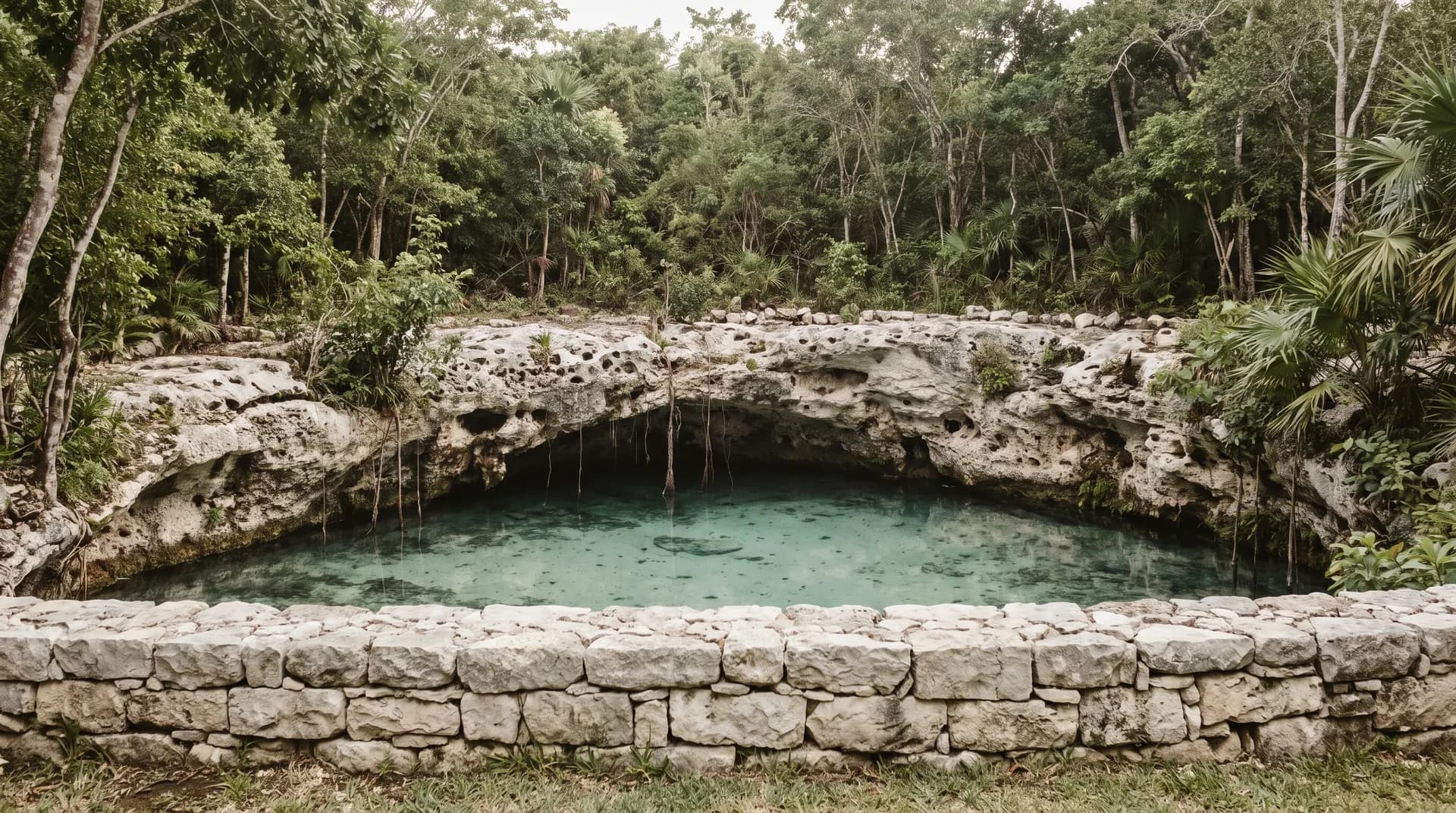
What is Tulum like to live in, beyond the beach?
It is a small, young municipality with a famous name: 46,721 residents at the 2020 census, more than seven in ten of them in the town itself, governed as a municipality only since 2008. The beach is one strip of it; most of what an owner deals with — services, permits, the people who come to the door — belongs to the town.
The name is older than the town and newer than the place. The national institute of anthropology records that fuentes del siglo XVI designan al sitio como “Zamá”, que en maya significa “mañana” o “amanecer”, and that Tulum, meaning wall or palisade, is the relatively recent name, after the wall that still stands around the clifftop site. The site's main entrance is en el km. 230 de la carretera federal Chetumal – Cancún, 128 kilómetros al sur de Cancún, and the same highway is the spine of the modern town.
The modern municipality was carved out by Decree 007 of the twelfth state legislature, which crea el Municipio Libre de Tulum, con cabecera municipal en la Ciudad de Tulum. Its own census profile, published by the state population council from INEGI figures, gives a population of 46,721 over 2,018.6 square kilometres, a density of 23.1 people per square kilometre, spread over 177 localities, of which the town of Tulum has 33,374 residents, Akumal 2,154 and Cobá 1,738. A municipality that size, eighteen years old, is still building the offices, rules and networks that older towns inherited, and a house bought there is bought inside that process rather than after it.
Then there are the questions the search box is full of — living in Tulum as an American, the size of the Tulum expat community. This guide does not give a number for either, because the only count with an official source is the national census, which records residents by place of birth rather than by passport, and a figure that cannot be opened at that source is a figure somebody repeated. What can be said without one is structural: a town where a share of the good houses belongs to people who live elsewhere is a town where many of those houses stand empty for part of the year, and that is what the rest of this guide is about. For an American owner the one legal fact that comes first is that the whole coast lies inside the faja del territorio nacional de cien kilómetros a lo largo de las fronteras y de cincuenta a lo largo de las playas, so the house is held through a bank trust; what that changes is set out in the guide to buying a house in Mexico as an American.
What do the town, the hotel zone and the jungle areas mean for a house?
They mean three different relationships with the same ground: the town is where the public networks are, the hotel zone is a coastal strip with its own arrangements, and the jungle areas sit beside land that federal decrees have closed to building. Which of the three an address belongs to decides what the house is connected to and what may be done around it.
The difference between the planned subdivisions and the beach road — what each is connected to, and what that changes for whoever holds the keys — is written out street by street on the page for property management in Tulum, and this guide does not repeat it. What it adds is the third edge, the one that does not show on a map of streets: the protected land.
There are four protected instruments around the town, and in July 2026 they were brought under one name. A presidential decree of that month records the national park declared on 23 April 1981 over una superficie de 664.32 hectáreas, ubicada en el municipio de Tulum, the zone of archaeological monuments of Tulum-Tancah declared on 8 December 1993, and the area known as Jaguar, and states that the Parque del Jaguar constituye un espacio de conservación ambiental, cultural y recreativa que integra el Parque Nacional Tulum, la Reserva de la Biosfera Caribe Mexicano, el Área de Protección de Flora y Fauna, Jaguar, y la Zona de Monumentos Arqueológicos.
The Jaguar decree of 2022 is the one that draws the hardest line. It covers una superficie total de 2,249-71-04.30 hectáreas, a core of 1,967 hectares and a buffer zone of 282, and in the buffer, the part that touches what is built, it lists among the prohibited activities realizar cualquier obra privada and the establishment of áreas habitadas o urbanizadas. For a house on the jungle side that is a neighbour that will not change, which is much of its appeal, and also a boundary that a fence, a path or a water line cannot cross without asking first.
| Date | What was decided | Instrument | What it changes for a house |
|---|---|---|---|
| 23 April 1981 | Parque Nacional Tulum, 664.32 ha | Federal decree | Protected land beside the town that will not be built on |
| 8 December 1993 | Zone of archaeological monuments of Tulum-Tancah | Federal decree | Federal heritage rules over the setting of the ruins |
| 19 May 2008 | Municipality of Tulum created, seat in the town | Quintana Roo legislature, Decree 007 | Local permits, rules and fees are those of an eighteen-year-old municipality |
| 27 July 2022 | Protected area Jaguar, 2,249 ha, with a 282 ha buffer | Federal decree, published in the DOF | No private works and no new settlement in the buffer zone |
| 1 December 2023 | Tulum international airport opens | Start of operations, recorded by the state government | The owner's arrival becomes a local trip rather than a regional one |
| 17 July 2026 | The four protected instruments joined as the Parque del Jaguar | Presidential decree, published in the DOF | One name for the protected land around the town |
What does the climate ask of a house there?
It asks the house to cope with water from above and water from below: 1,120.5 millimetres of rain a year at the town's own weather station, with September and October the wettest months, falling on rock that lets it straight through to the aquifer. Heat is constant and mild, so the work is about moisture, salt and storms, not temperature.
The national weather service's normal for the station named Tulum, in the municipality of Tulum, at ten metres above sea level, issued on 9 October 2026, records a mean annual temperature of 25.6 °C and 1,120.5 mm of rain over 71.8 rainy days, with September and October the two wettest months at 177.1 and 204.2 mm. The Atlantic hurricane season, as the National Hurricane Center puts it, runs from June 1 to November 30, and the Caribbean coast shares it. How those months fall for a house that is closed is set out month by month in the guide to the weather in Tulum, what a storm season asks of an owner on this coast in the guide to hurricane season in Cancún, and the summer seaweed in the guide to sargassum.
What is particular to Tulum is the ground the rain lands on. The 2022 decree describes the area as part of the subprovincia Carso Yucateco, a nearly flat platform of limestone, dolomite and gypsum at an average altitude of thirty metres, in which the karst relief propicia la generación de cavidades horizontales conocidas como dolinas formadoras de cenotes. The water moves underneath rather than across the surface. For a house that means rain does not run off a garden and away; it goes down, and so does anything that leaks.
What changed with the train and the new airport?
The distance between an owner and the house shrank: since December 2023 Tulum has its own international airport, and the Maya Train stops twice in the municipality, once in the town and once at the airport. A journey that used to finish with 128 kilometres of highway from Cancún can now finish inside the municipality.
The state government records that the airport desde 1 de diciembre de 2023 que inició operaciones se ha consolidado como una terminal aérea con gran dinamismo para el Caribe Mexicano, and by August 2025 it had handled more than 2,066,000 passengers. The federal tourism ministry announced that for la temporada de invierno 2026-2027 the airport will have seasonal flights to five destinations in Canada and the United States, among them Newark from 17 December 2026 to 24 January 2027. Seasonal is the word to keep: the direct routes announced follow the winter, and their dates are worth checking each year rather than assumed.
The train's own station list carries two entries for the municipality, Tulum and Tulum Aeropuerto, and describes the natural setting of the first in terms an owner should read literally: wetlands, dune vegetation, jungle, cenotes and beaches, which together form el ecosistema del Parque Nacional Tulum y del Parque del Jaguar. Faster arrival changes how often an owner can come; it does not change who is at the house on the days in between.
What does a house need when its owner is there only part of the year?
It needs a record of the water — what the house draws, what it treats and what it sends down — and someone present on the days when the weather or a supplier decides. On porous limestone, a small leak or a failing treatment system does not announce itself on the surface; it goes into the ground.
The federal decree is explicit about the size of what lies underneath. It records that the area sits partly over uno de los más extensos e importantes acuíferos kársticos del mundo, en el que se registran por lo menos 2,000 kilómetros de pasajes subterráneos, among them the Sac Actun and Ox Bel Ha systems, which belong to the Great Maya Aquifer. In its buffer zone the same decree forbids discharging cualquier tipo de desechos orgánicos, residuos sólidos o líquidos o cualquier otro tipo de contaminante into the ground or into any aquifer. The rule binds the protected land, but the geology does not stop at its edge, and the same logic reaches every house in town.
So the brief for an absent owner here has a particular shape. Four items carry most of it, and none of them is urgent on the day it is agreed, which is why it is worth agreeing.
Most of that is maintenance with a date on it, which is what preventive maintenance means in practice, and all of it produces paper that is wanted months later. It belongs with the amounts, in the monthly owner statement, so that a question asked in March about an October leak has somewhere to land.
Who looks after it the rest of the time?
Someone who works for the owner and answers for the whole house: keys, suppliers, the maintenance calendar and the accounts, in one place and in writing. In a town this young the tasks are not exotic; what matters is that one person is accountable for all of them.
That is the job described in the guide to what a property manager does, and in its full form as luxury property management. What changes in Tulum is the list of things to watch rather than the role: the water underneath, the protected edges, the wet autumn and a coast that shares the Caribbean storm season. How that is organised for a house in each part of the town is on the page for Tulum.
What is it like living in Tulum?
Tulum is a small and young municipality with a famous name. It was created by Decree 007 of the Quintana Roo legislature, published on 19 May 2008, with its seat in the town of Tulum. At the 2020 census it had 46,721 residents over 2,018.6 square kilometres, of whom 33,374 lived in the town itself, 2,154 in Akumal and 1,738 in Cobá. The town sits on the federal highway 128 kilometres south of Cancún, beside the clifftop Maya site that sixteenth-century sources called Zamá, meaning morning or dawn. Since December 2023 it has had its own international airport, and the Maya Train stops twice in the municipality.
How many Americans live in Tulum?
There is no official count by nationality to quote. The only source with official standing is the national census run by INEGI, which records residents by place of birth rather than by passport. A figure for the size of the foreign community that cannot be traced to that source is an estimate somebody repeated, so it is better left out than repeated again.
What is the Parque del Jaguar in Tulum?
It is the name under which a federal decree published on 17 July 2026 brings together four protected instruments around Tulum: the Parque Nacional Tulum, declared on 23 April 1981 over 664.32 hectares; the Reserva de la Biosfera Caribe Mexicano; the protected area of flora and fauna known as Jaguar, declared on 27 July 2022 over 2,249 hectares; and the zone of archaeological monuments of Tulum-Tancah, declared on 8 December 1993. In the buffer zone of the Jaguar area, the 2022 decree forbids any private works and the establishment of new settled or urbanised areas.
What is under the ground in Tulum?
Limestone, and water. The 2022 federal decree on the Jaguar area describes the region as part of the Yucatán karst, a nearly flat platform of limestone, dolomite and gypsum whose relief favours the filtration of water into the subsoil and forms the sinkholes known as cenotes. It records that the area sits partly over one of the largest karst aquifers in the world, with at least 2,000 kilometres of underground passages, including the Sac Actun and Ox Bel Ha systems of the Great Maya Aquifer. For a house this means rain and anything that leaks go down into that water rather than running off.
Can an American own a house in Tulum?
Yes, through a bank trust. The Mexican foreign investment law defines the restricted zone as the strip of national territory one hundred kilometres wide along the borders and fifty kilometres wide along the coasts, and Tulum's coast lies inside it. Within that zone a foreign individual holds residential property through a trust held by a Mexican bank rather than in direct ownership. The terms of the trust, its duration and its renewal are matters for the notary and the bank handling the purchase.