Living in Acapulco, and owning a house there
Living in Acapulco is usually described from the bay. What reaches a house is a different set of facts: a municipality of 779,566 people, the most populous in Guerrero, a coastline whose building rules are set by sector rather than by the names on the tourist map, and a hurricane season that in 2023 brought the strongest landfalling hurricane on record in the eastern Pacific basin.
This guide answers the questions people ask before they buy — what the city is, what the zones mean, what Otis changed — only as far as it takes to reach the question they ask afterwards: what the house needs while they are somewhere else. How a house is looked after in full, from keys to accounts, is set out under luxury property management.
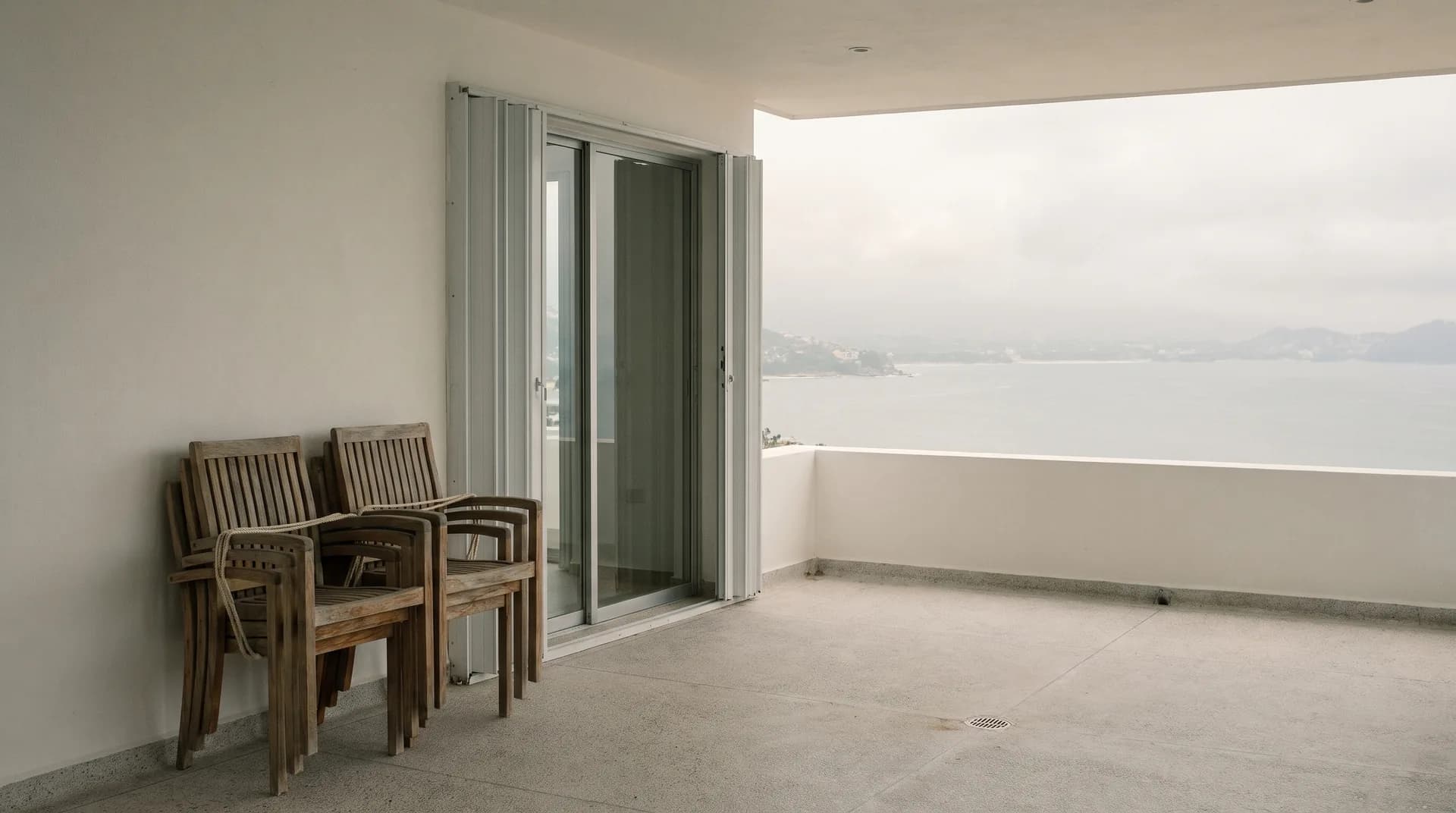
What is Acapulco like to live in, beyond the bay?
It is a large city, the biggest in its state, and the hotel strip along the bay is only its front edge. Living in Acapulco, Mexico, as a resident means the city behind it, and the services a house depends on: water, power, roads and the people who keep it.
The census gives the scale. The municipality of Acapulco de Juárez had 779,566 residents in 2020, and across Guerrero INEGI counts 942,043 inhabited homes, against 657,577 in 2000. The share of homes in the state with piped water rose from 59.8 per cent in 2000 to 88.5 per cent in 2020, which is one reason a house there is checked for its water supply as well as its roof.
Expats living in Acapulco appear in the census only inside a state figure. INEGI records place of birth, and for the whole of Guerrero it counts 18,046 residents born in another country, of whom 16,466 were born in the United States. A number for the city alone would have to come from INEGI's detailed tables.
For an American owner the legal fact that comes first is that the coast lies inside the restricted zone, la faja del territorio nacional de cien kilómetros a lo largo de las fronteras y de cincuenta a lo largo de las playas, so a house there is held through a bank trust; what that changes is set out in the guide to buying a house in Mexico as an American.
What do Acapulco Tradicional, Dorada and Diamante mean for a house?
They are the names of the tourist map, and they say where a house is, not what may be built there. The lines that decide something for a house are drawn by other documents: a federal decree for Punta Diamante, and the municipal plan's setbacks from the sea.
The Diamante zone has a legal origin of its own: a federal decree of 1987 declared de utilidad pública el desarrollo de la zona conocida como Punta Diamante for a tourist complex. Where each of the three zones begins, and how each is reached from Mexico City, is the subject of the guide to Acapulco Diamante, Dorada and Tradicional.
The municipal urban development plan sets how far a building stays back from the federal beach zone, and it does so by three sectors, Anfiteatro, Pie de la Cuesta and Diamante, not by the three tourist names. The table sets the rules that matter for a house beside the document that fixes each one.
| Rule | Set by | What it means for a house |
|---|---|---|
| Restricted zone, 50 km from the beaches | Foreign Investment Law, art. 2 | A foreign owner holds the house through a bank trust |
| Setback in the Anfiteatro sector | Municipal plan, art. 89 | 10 m on cliffs, 20 m on the beach |
| Setback in the Pie de la Cuesta sector | Municipal plan, art. 89 | 10 m on cliffs, 20 m on the beach |
| Setback in the Diamante sector | Municipal plan, art. 89 | 15 m on cliffs, 30 m on the beach |
| Eastern Pacific hurricane season | National Hurricane Center | 15 May to 30 November |
In those setback strips, article 89 says, sólo se permiten albercas, palapas, espacios recreativos sin construcción y jardines. For an owner the practical consequence is simple: what stands between the house and the sea is a pool, a garden or a terrace, and it is the first thing the weather reaches.
What did Hurricane Otis change for owners?
It showed that the strength of a storm can be unknown until the last hours, so preparation that depends on a forecast comes too late. What protects a house is what was finished before the season opened and what was recorded about its condition.
Otis made landfall near Acapulco on 25 October 2023 as a category 5 hurricane, and the National Hurricane Center's report states that the extreme RI of Otis was not anticipated by NHC forecasters or the intensity guidance. A year later Hurricane John brought the opposite problem, water rather than wind: a storm total rainfall of 1442 mm was recorded at Acapulco, most of it in three days.
What that means in practice — the timing of warnings, the work done before the season and the record kept of a house — is set out in the guide to a hurricane in Acapulco. For a house whose owner lives elsewhere, the lesson of the two storms is the same: roof, drains, shutters and the inventory of the house are dealt with before 15 May, not when a warning is issued.
What does the climate ask of a house there?
Moisture, more than heat: a hurricane season that covers half the year, and humid coastal air that a closed house cannot dry on its own. Every other task follows from those two.
The hurricane season in the eastern Pacific runs from May 15 to November 30, with a peak in late August. How much rain falls in each month, and how the temperature moves through the year, is the subject of the guide to Acapulco weather.
Moisture is the part that works on a closed house. The US Environmental Protection Agency advises keeping indoor humidity below 60 percent (ideally between 30 and 50 percent) and drying wet areas within 24-48 hours to prevent mold growth. In a house nobody is living in, nobody notices a leak or a damp wall within two days unless someone is scheduled to look.
What does a house need when its owner is there only part of the year?
It needs someone who opens it on a fixed schedule, keeps the air dry, checks water, roof and drains, and closes it properly before the season. And it needs a written record of each visit, so the owner knows its condition without being there.
Most of that list is ordinary preventive maintenance, and over a year it is what an annual plan puts on a calendar with dates.
Who looks after it the rest of the time?
Either the owner arranges it piece by piece with local suppliers, or one office takes the house on whole and reports every month. The second is what property management means when the owner lives in another city or another country.
What that service covers in Acapulco — the visits, the maintenance, the preparation for the season and the monthly report — is set out on the page for property management in Acapulco. Concierge services, if they are wanted, are optional and charged per use, never included in the fee.
What is it like living in Acapulco?
Acapulco de Juárez is the most populous municipality in Guerrero, with 779,566 residents at the 2020 census. For a house owner, living there means a warm, humid climate, building rules set by sector along the coast, and a hurricane season from 15 May to 30 November.
How many Americans live in Acapulco?
INEGI does not publish a figure for the city alone in its census summary. For the whole state of Guerrero, the 2020 census counted 18,046 residents born in another country, of whom 16,466 were born in the United States.
Can a foreigner own a house in Acapulco?
Yes, through a bank trust. Acapulco lies within the restricted zone defined by the Foreign Investment Law, the strip of fifty kilometres along the beaches, where a foreign buyer holds residential property through a trust rather than directly.
When is hurricane season in Acapulco?
Acapulco is on the eastern Pacific, where the hurricane season runs from 15 May to 30 November according to the US National Hurricane Center, with a peak in late August.