What it is to live in San Miguel de Allende
Most of what is written about what it is to live in San Miguel de Allende describes a place. What reaches a house is narrower and older than the place: the outside of a building in this town has needed written permission since 1939, when a federal law declared the city a Población Típica and ruled that no new work could be undertaken without prior written authorisation. The monument-zone decree came in 1982 and the UNESCO inscription in 2008, so an owner arriving today inherits three layers of protection rather than one, and the oldest of them is the one that decides what may be done to a façade.
This guide answers the question people ask before they buy — what the town is, what the stone is, what the year does to a colonial house — only as far as it takes to reach the question they ask afterwards, which is what that house will need from them while they are somewhere else. What looking after one there involves, and who stands at which window, is on the page for San Miguel de Allende.
What is San Miguel de Allende known for?
For an eighteenth-century town centre that three separate instruments describe in writing, and for the foreign residents who have been arriving since the middle of the last century. Only the first of those reaches a house: the second changes who the neighbours are, the first changes what may be done to the walls.
The written part is precise and it is worth reading before the postcard. San Miguel de Allende and the shrine at Atotonilco were declared a Zone of Historical Monuments on July 28, 1982 and were inscribed by UNESCO on the World Heritage List on July 8, 2008, in the Institute's own words, for their cultural and architectural importance and for the town's role in the struggle for the independence of Mexico. The name the Mexican state put on the nomination is not the one the tourist board uses: it is Villa Protectora de San Miguel y Santuario de Jesús Nazareno de Atotonilco, and the word protectora is literal — the town was fundada en el siglo XVI para proteger el Camino Real de Tierra Adentro.
What the inscription praises is, unusually, the private houses rather than the churches. The management plan records that the town's mansiones urbanas son excepcionalmente grandes y ricas para un pueblo latinoamericano de tamaño mediano y constituyen un ejemplo de la transición del estilo barroco al estilo neoclásico, and the Institute adds that the Baroque style predominates in its houses and churches. An owner should read that as a description of their own asset and not of the skyline: the thing the world list is protecting is, in a good many cases, somebody's front door.
Then there is the other half of the reputation, and it is the half the search box is full of. The questions people type — moving to San Miguel de Allende, San Miguel de Allende expats, how many Americans live in San Miguel de Allende — all want a number, and this guide does not give one, because the only count with an official source is the national census, which records residents by country of birth rather than by passport and publishes at municipal level. A figure for the San Miguel de Allende expat community that cannot be opened at an official source is a number somebody repeated, and repeating it again would not make it true. What can be said without a source is structural: a town whose foreign-born residents are a standing part of the population is a town where a large number of good houses stand empty for part of the year, and that is the condition the rest of this guide is about.
What does a UNESCO historic centre mean for a house and its façade?
It means the outside of the house has been regulated for longer than the inscription has existed, and that the 2008 listing added an international commitment on top of two Mexican instruments that were already binding. For an owner the practical translation is short: work on the exterior is authorised before it is quoted, and which perimeter the address falls in decides how much of the year that takes.
The 1939 law is the one nobody expects and the one that reads most severely. Reproduced in the municipal management plan, it declares the whole urbanised area a Población Típica and then states that no podrán llevarse a cabo, dentro de la ciudad, construcciones que no estén de acuerdo con el estilo arquitectónico de la misma, and that no podrá emprenderse ninguna obra nueva sin que previamente se haya obtenido autorización escrita. That is eighty-seven years of a town in which the answer to what colour to paint the front has never been the owner's alone.
The 1982 decree drew the line on a map and counted what was inside it. The management plan records that la zona de decreto está formada por las 68 manzanas of buildings of historic value raised between the sixteenth and nineteenth centuries, and its own table of catalogued buildings puts 257 of them inside the decree, of which 209, or 81.31 per cent, stand in perímetro A. Four fifths of the protected stock in one perimeter is why an address inside it behaves differently from an address two streets out.
The 2008 inscription then added a second geometry over the first. The property was recognised bajo los criterios culturales (ii) y (iv), with 43,26 hectáreas para la zona núcleo, más 24,04 y 16,01 hectáreas de zonas 1 y 2 de protección in the town itself and a further core and protection zone at the shrine, so that el total del bien considerado abarca 100,01 hectáreas, surrounded by a buffer whose área total inscrita es de 84.79 ha. Two perimeters drawn a quarter of a century apart do not coincide street for street, which is the single most useful thing to establish about an address before anything else is decided about it.
| Instrument | Year | What it covers | What it changes for a house inside it |
|---|---|---|---|
| Ley de protección y conservación, declaring the city a Población Típica | 1939 | The whole urbanised area of the city as it then stood | No new work without prior written authorisation, and nothing out of keeping with the architectural style of the town |
| Decree of a Zone of Historical Monuments | 1982 | 68 blocks, containing 257 catalogued buildings, 209 of them in perímetro A | Federal jurisdiction over works, whether or not the building is itself catalogued |
| UNESCO World Heritage inscription | 2008 | 100.01 ha of property under cultural criteria (ii) and (iv), plus 84.79 ha of buffer zone | An international commitment on top of the federal one, and a buffer in which changes are also watched |
| Municipal management plan and partial plan for the historic centre | 2018 onward | The polygons A, B1, B2 and C1 to C5, and the local rules inside them | A municipal paper that has to exist before the federal file is complete |
None of that is the procedure, and this guide deliberately stops short of it. Which works count as major, what the file has to contain, how long the Institute has to answer and who may sign on an owner's behalf are set out in full on the page for property management in San Miguel de Allende, which is also where the difference between an address inside the perimeter and one outside it turns into a calendar.
What is cantera stone, and what does it ask for?
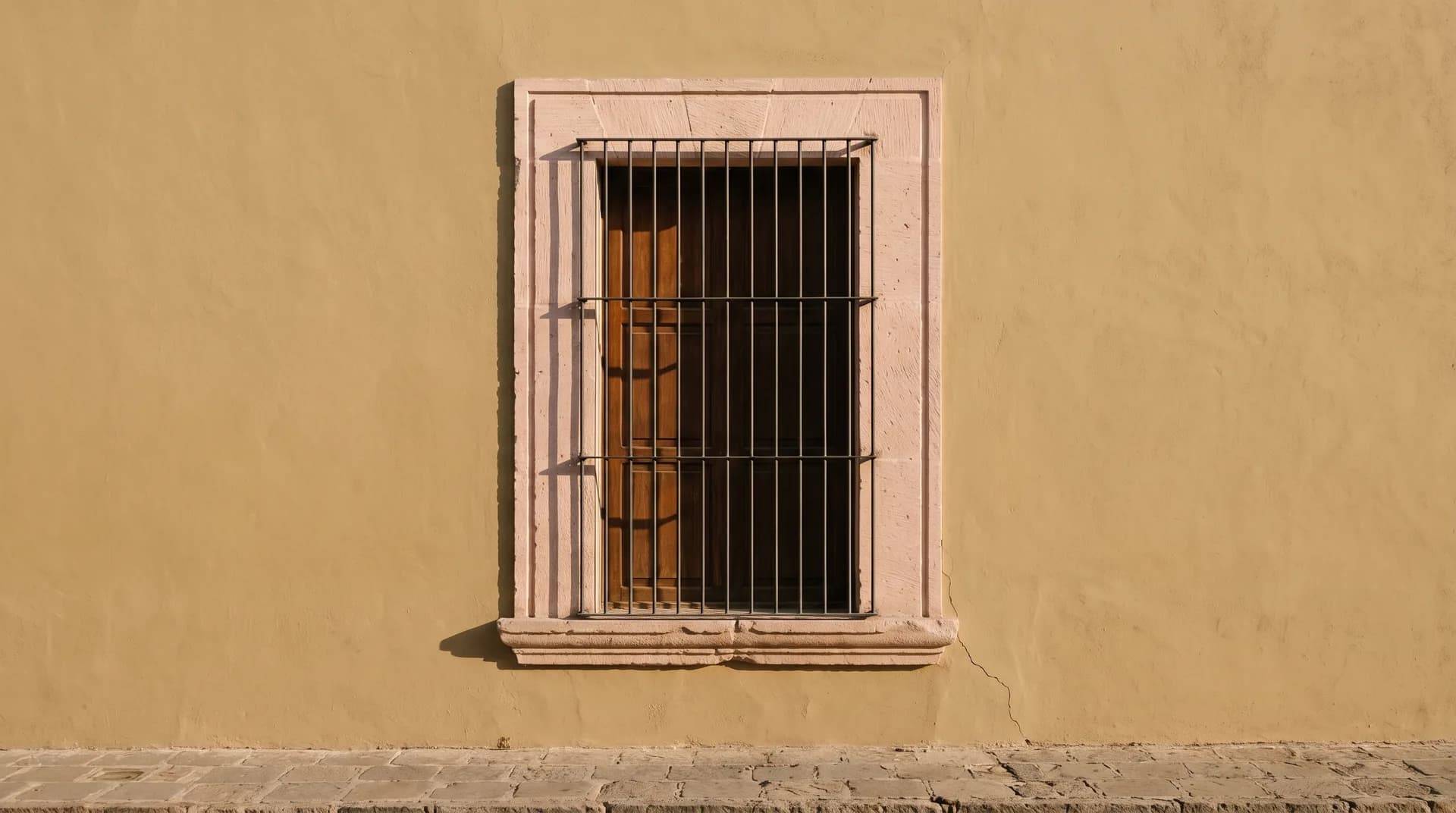
Cantera is the volcanic tuff that the doorways, window surrounds, columns and boundary walls of this part of Mexico are cut from, and it is soft — the state's own mineral inventory records a Guanajuato bank of it at 2 to 2.5 on the Mohs scale. What cantera stone asks for is that nothing harder than itself is ever taken to it, and that any repair to it is treated as a permitted work rather than as a mason's morning.
The geological description is plainer than the architectural one. In its physical inventory of the mineral resources of a Guanajuato municipality, the national survey describes a working cantera bank as a stone that es una toba riolítica de color rojo, a rosa claro, that is compacta, poco permeable, con dureza de 2 a 2.5 según la escala de Mohs, and that se puede usar para hacer bardas, fachadas, marcos, columnas. Two on the Mohs scale is softer than a copper coin. Every tool, brush, jet and cleaning product that a contractor might reach for on a Saturday is harder than the stone it is being used on, and the damage that follows is not a stain but a loss of surface, which is permanent.
It is also the material the town is famous for at its most visible. The Institute describes the parish church as a building whose neo-Gothic façade, built in pink cantera stone, makes it exceptional, and its catalogue entries for the smaller chapels are written in the same terms — one of them is simply recorded as having a facade and tower made of cantera stone. The same stone that carries the skyline carries the surround of an ordinary window on an ordinary street, and the federal regime does not distinguish between the two by fame.
What that adds up to for an owner is a short instruction with a long consequence. Cantera is cleaned by people who have cleaned cantera, at a pressure and with a medium chosen for a stone of that hardness; a crack in a surround is photographed and dated rather than filled; and because a modification to the exterior is a permitted work, the slowest step in repairing a piece of carved stone is never the carving. A house whose cantera was repaired without a file has nothing to hand over when the question is eventually asked, and the question is asked when the house changes hands.
What does the dry highland climate do to a colonial house?
It does the damage on the inside instead of announcing it on the outside, because there is no salt up here and the air is dry for most of the year. The official classification for the area is semi-dry and temperate with summer rain, and the wear that matters arrives in three or four months of that rain finding its way through the roof coverings.
The numbers are worth having in front of an owner who is used to a coast. The federal water commission's study of the local aquifer classifies the climate as semiseco, templado, con lluvias en verano with a short mid-summer dry spell, and records that la precipitación media anual varía de 600 mm en el extremo sur en el área de la Presa Ignacio Allende a 800 mm en el flanco oriental de la Sierra de Guanajuato. The temperature is gentler than most visitors expect in either direction: la temperatura media anual es del orden de 16° C, the warmest months are April, May and June at monthly means between 18 and 22 degrees, and the coldest are December, January and February at between 11 and 14.5. The town sits a una altura de mil novecientos diez metros sobre el nivel del mar, which is what keeps the summer mild and the winter nights cold.
Mild is not the same as kind, and the management plan says where the damage actually enters. Among the threats it lists for the site are climatic factors that increasingly affect the material and structural conservation of the buildings, por lo general debido a las condiciones de altas temperaturas que permiten el ataque de micro-organismos (hongos, líquenes, bacterias), así como de insectos, and a second, blunter one: there is limitado control de filtraciones, especialmente de los revestimientos de las cubiertas de las edificaciones. Roof coverings are the whole story of a rainy season in a masonry house. Water that gets past them in July shows up on a wall in October, and by then nobody can say which storm did it.
The conclusion the plan draws for the monuments is the same one an owner should draw for a house, and it is a scheduling conclusion rather than a repair one: the site requires un permanente monitoreo de las condiciones climáticas, así como una mayor y mejor protección preventiva. In practice that means the roof is inspected before the rains rather than after them, and the inspection has a date on it. It is the opposite discipline from the coast, where the damage is on the outside and visible from the street — what a house on a warm coast actually asks for, month by month, is set out in the guide to the weather in Acapulco, and almost none of it applies here.
What does the calendar of festivals change for an owner?
It puts the historic centre inside a continuous public programme for more than five weeks of the autumn, and the biggest night of it moves from one year to the next. In 2026 the municipal programme runs from 5 September to 11 October, with the fair from 18 September to 4 October and La Alborada in the small hours of 3 October.
The municipality publishes the whole thing, which is what makes it plannable from abroad. Its own announcement describes a season that is no se trata de un solo evento, sino de varias semanas en las que coincidirán actividades en el Centro Histórico, recorridos por calles de la ciudad, opening with the coronation on 5 September and the pega del Bando on the 8th, carrying the civic ceremonies of 15 and 16 September, and then continuing: el 18 de septiembre comenzará la Feria San Miguel de Allende 2026, que se extenderá hasta el 4 de octubre. The patronal part peaks durante la madrugada del 3 de octubre con La Alborada, and the programme runs on hasta el 11 de octubre con la Octava de la Fiesta.
What that means for a building rather than for a visitor is a matter of streets. The same announcement notes that an agenda of this size requires a cross-cutting municipal operation, in which Seguridad, movilidad, Protección Civil, servicios públicos, cultura y las áreas responsables deberán coordinar recorridos, concentraciones, espacios públicos y eventos de distinta naturaleza durante varias semanas. Coordinated routes and gatherings are closed streets. On a street where the only way in is one doorway, and where scaffolding, lime and stone all have to be carried through it, five weeks of processions is five weeks in which nothing heavy reaches the house.
The second consequence is a diary problem rather than an access one, and it catches owners in their first year. The date of the patronal peak is tied to the feast of the archangel rather than to a fixed number, so it lands on a different day each year and cannot be remembered — it has to be looked up, in the year it applies to, before anything outdoors is scheduled. Put the published programme beside a permit that runs for a fixed term and beside a rainy season that closes the summer, and the window in which exterior work can actually happen is narrower than the dry season suggests: it is what is left of it once the autumn is spoken for.
What does a house need when its owner is there only part of the year?
Someone who can be physically present on a date nobody can predict, and a written record of the two things here that never announce themselves: what the roof did in the rains, and what the water is doing inside the installations. Neither is visible from the street, and an empty house generates no complaint about either.
The water is the constraint most owners discover last, and it is documented at federal level. The aquifer beneath the town, keyed 1107 and covering some 358 square kilometres almost entirely within the municipality, has its territorio completo sujeto a las disposiciones de tres decretos de veda dating from 1949, 1958 and 1964, and the 2024 balance is explicit about what is left: no existe un volumen disponible para otorgar nuevas concesiones; por el contrario el déficit es 12,380,155 m3 anuales. Nearly all of the extraction is agricultural rather than domestic — the census of uses puts uso agrícola 95.73 % against 3.52 per cent public-urban — but the arithmetic reaches a private house all the same, because it is the reason a new well is not a solution to anything.
The chemistry reaches it more directly. The same study reports that fluoride in the area, owing to the geological environment, presenta una concentración por arriba de la norma de la Organización Mundial de la Salud que establece un máximo de 1.5 mg/l, with anomalous values principalmente al norte de la ciudad de San Miguel de Allende, donde es posible medir concentraciones de hasta 3.78 mg/l, and that the dominant water is bicarbonatada sódica, typical of volcanic settings. Water of that character is why treatment equipment exists in most good houses here, and why it is the single installation in the building most likely to fail quietly while nobody is looking at it. Whether the specific supply at one address needs treatment, and of what kind, is a measurement at that address rather than a rule for the town.
So the brief for an absent owner in this town has an unusual shape, and it is worth writing down before the first year rather than after it. Four items carry most of it, and none of them is urgent on the day it is agreed, which is precisely why it gets agreed.
Those four produce paper, and paper that lives in messages is gone by the time it is wanted. It belongs where the amounts already are: in the monthly owner statement, so that a question asked in March about a July roof has somewhere to land. The other thing worth settling early is the deed itself, since an owner here holds it outright rather than through a bank trust — inland towns fall outside the restricted zone — and what that changes, and what it does not, is set out in the guide to buying a house in Mexico as an American.
What is San Miguel de Allende known for?
For an eighteenth-century colonial centre protected in writing three times over, and for a long-established foreign resident population. San Miguel de Allende and the shrine of Jesús Nazareno de Atotonilco were declared a Zone of Historical Monuments on 28 July 1982 and inscribed by UNESCO on the World Heritage List on 8 July 2008, under cultural criteria (ii) and (iv), for their cultural and architectural importance and for the town's role in Mexico's struggle for independence. The nomination's own name for the property is Villa Protectora de San Miguel y Santuario de Jesús Nazareno de Atotonilco, and the town was founded in the sixteenth century to protect the Camino Real de Tierra Adentro. What the inscription singles out is unusual: the private urban mansions, described as exceptionally large and rich for a medium-sized Latin American town and as an example of the transition from Baroque to Neoclassical.
What is cantera stone?
Cantera is a volcanic tuff, cut and carved for doorways, window surrounds, columns and boundary walls across central Mexico. The Mexican geological survey's physical inventory of mineral resources in Guanajuato describes a working bank of it as a rhyolitic tuff, red to pale pink, compact and barely permeable, with a hardness of 2 to 2.5 on the Mohs scale, suitable for walls, façades, surrounds and columns. That hardness is the practical point for an owner: at 2 to 2.5 the stone is softer than a copper coin, so almost any tool, brush or cleaning product a contractor might reach for is harder than the surface it is being used on, and what it removes is not a stain but the carved face itself.
Does a house in San Miguel de Allende need permission to change its façade?
Yes, and the requirement is much older than the UNESCO listing. A federal law of 1939 declared the city a Población Típica, ruled that no construction out of keeping with the town's architectural style could be carried out within it, and required prior written authorisation before any new work. A decree of 28 July 1982 then established a Zone of Historical Monuments covering 68 blocks and 257 catalogued buildings, 209 of them in perímetro A, which brings works under federal jurisdiction whether or not the individual building is itself catalogued. The 2008 World Heritage inscription added an international commitment over 100.01 hectares of property and an 84.79-hectare buffer zone. Which works need what, and how the file is assembled, is a procedure with its own deadlines.
What is the water like in San Miguel de Allende?
Scarce and chemically distinctive, and both facts are documented federally. The San Miguel de Allende aquifer, key 1107, covers about 358 square kilometres almost entirely inside the municipality, its whole territory is subject to three groundwater veda decrees dating from 1949, 1958 and 1964, and the 2024 availability update concludes that there is no volume available for new concessions and that the deficit is 12,380,155 cubic metres a year, with 95.73 per cent of extraction going to agriculture. The same study reports fluoride above the World Health Organization limit of 1.5 mg/l because of the geological environment, with concentrations of up to 3.78 mg/l measured mainly north of the city, and a dominant sodium bicarbonate water typical of volcanic settings. Whether one address needs treatment, and of what kind, is a measurement at that address.
When are the festivals in San Miguel de Allende, and do they affect a house?
They occupy the historic centre for more than five weeks in the autumn, and the dates move from year to year because the patronal feast is tied to the archangel's day rather than to a fixed number. The municipal government's published programme for 2026 runs from the coronation on 5 September, through the pega del Bando on 8 September and the civic ceremonies of 15 and 16 September, to the Feria San Miguel de Allende from 18 September to 4 October, La Alborada in the early hours of 3 October, and the Octava de la Fiesta on 11 October. For a building the consequence is access: the municipality states that security, mobility, civil protection, public services and culture must coordinate routes, gatherings and public spaces for several weeks, and coordinated routes are closed streets. On a house whose only way in is one doorway, that is several weeks in which nothing heavy reaches it.